If Your AI Strategy Doesn't Start With Attribution, You're Just Automating Guesswork

Every Sales and Marketing leader has felt the pull of the AI agent wave. Microsoft Copilot writes the follow-up email. Google Gemini drafts the campaign brief. Anthropic's Cowork takes notes and proposes next steps. Lindy and Martin handle the personal workflow plumbing. The pitch is irresistible: hand off the busywork, free up your team, watch productivity climb.
But six to twelve months into these rollouts, an uncomfortable question keeps surfacing in boardrooms: what actually changed in the numbers?
Semantic Brain believes the honest answer, for most organizations, is "not much." And the reason isn't that the agents are bad. It's that the strategy underneath them skipped the only step that matters — attribution.
The Default AI Playbook Has a Foundation Problem
The standard approach to deploying AI agents in Sales and Marketing looks roughly like this: pick a use case, deploy the agent, measure adoption, hope for ROI.
Adoption gets measured. Time-saved gets estimated. Productivity gets self-reported. But the line connecting any of that to pipeline, revenue, or customer outcomes is almost never drawn — because the baseline was never established in the first place.
This is the difference between automating a process and optimizing an outcome. Automation tools like Copilot, Gemini, Cowork, and the broader category of personal agents (Lindy, Martin, OpenClaw) learn from unstructured data — your emails, your calls, your documents — and get progressively better at replicating what your team already does. They learn from past behavior.
That's a real productivity gain. But it's also a trap. If your team's existing behavior is 70% effective, an AI agent that perfectly mimics that behavior just makes you 70% effective faster and cheaper. You're not improving the business. You're scaling the average.
Optimization Starts With Knowing What "Better" Means
Semantic Brain takes a different starting position. Before any agent runs, before any workflow is automated, the platform performs attribution — establishing a measurable baseline of what's actually driving outcomes in your Sales and Marketing motion today.
That baseline is what makes everything downstream meaningful. Without it, "improvement" is a feeling. With it, every subsequent iteration of the Semantic Growth Twin can be measured against a known starting point and tied directly to organizational impact.
This is what Semantic Brain calls the Semantic Growth Twin — a system that doesn't just learn from how your team behaves, but from how that behavior affects the business.
Semantic Growth Twin vs. Automation and Personal Agents
The comparison below applies to Sales, Marketing, and Product Management (it deliberately excludes coding workflows, where the dynamics are different):
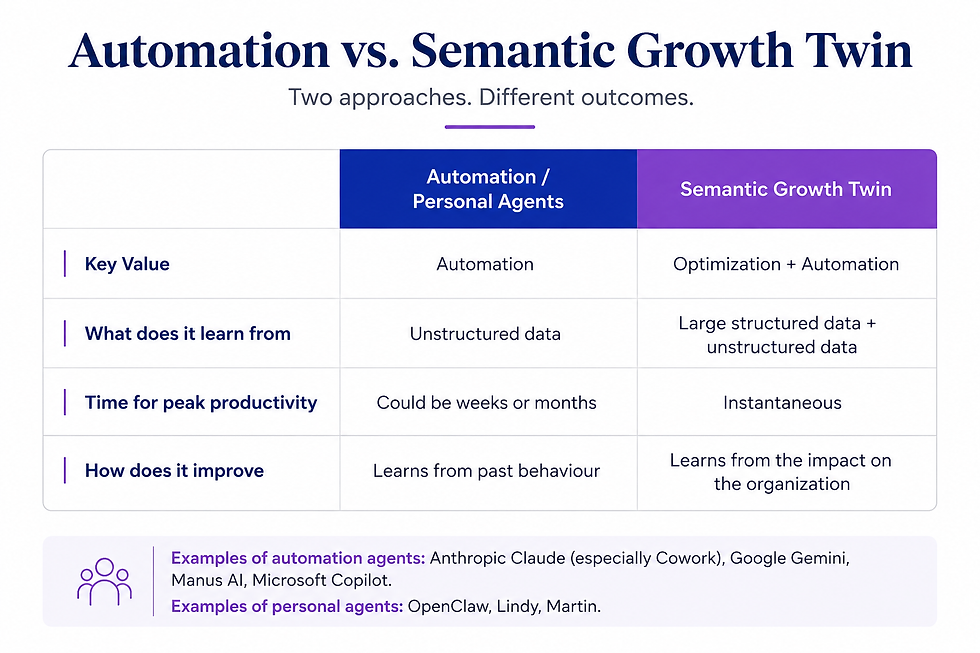
The four rows of that table represent four compounding advantages. Automation alone gets you speed. Optimization plus automation gets you speed toward the right things. Unstructured data alone teaches an agent your team's habits. Large structured data plus unstructured data teaches it your business's actual performance signals. Peak productivity in weeks or months becomes peak productivity from day one. And the deepest difference — learning from organizational impact rather than past behavior — is what separates a system that helps your team work from a system that helps your business grow.
How the Architecture Actually Works
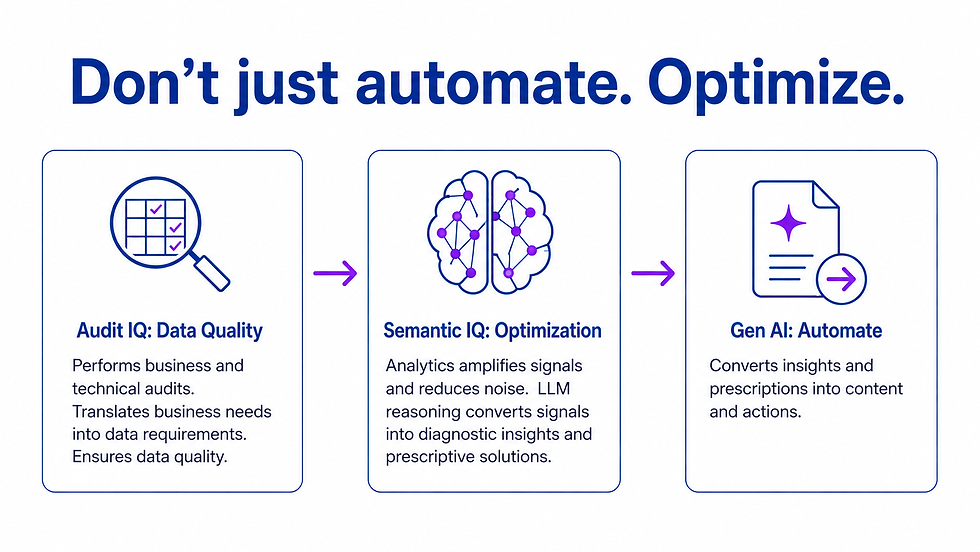
Attribution alone isn't enough. To act on the baseline, the Semantic Growth Twin needs an architecture that can extract signal from the noise of modern Sales and Marketing data — and do so efficiently enough that reasoning agents can focus on judgment, not on wading through raw data.

The flow looks like this. Data and analytics are extracted from the platforms where Sales and Marketing actually happen — Google, LinkedIn, and Meta. BizML then amplifies the meaningful signals and reduces noise, so the reasoning agents inside Semantic IQ work with a much smaller, pre-computed, business-relevant slice of the data rather than the full firehose.
The result is that institutional memory only persists where it matters: in Signals, Deep Diagnostic Insights, and Recommendations. Other agents operate on this distilled layer rather than on raw data. This is what makes the "instantaneous time to peak productivity" claim in the table above structurally true rather than aspirational — the system doesn't need months of behavioral observation to start producing value, because attribution and the curated signal layer give it the context it needs from day one.
How This Differs From Other Enterprise LLM Initiatives
Most enterprise LLM rollouts — even the well-resourced ones — optimize. They iterate on prompts, fine-tune on internal documents, and refine workflows. What they typically don't do is start with attribution and a baseline. ROI measurement gets bolted on afterward, if at all, and the business case for the initiative tends to live in productivity proxies rather than outcomes.
Semantic Brain inverts that order. Attribution comes first. The baseline is established at onboarding. Business objectives and ROI measurement are built into the platform's foundation, not retrofitted onto its outputs. And then — only then — does continuous optimization begin, with every iteration measurable against the baseline that was established at the start.
This is the meaningful distinction. It isn't continuous optimization versus one-time optimization. It's continuous optimization grounded in attribution versus continuous activity that no one can tie back to the business.
The Question to Ask Before Your Next AI Investment
The AI agent market will keep moving fast. New tools will keep launching. The temptation to deploy the latest agent in the hopes that this one will finally show up in the revenue line will keep getting stronger.
Before the next deployment, Semantic Brain suggests one question for every CMO, CRO, and Head of RevOps to ask the team proposing it: what is our current baseline, and how will we attribute any improvement back to this investment?
If the answer is some version of "we'll figure that out later," the deployment isn't an AI strategy. It's automated guesswork.
The attribution-first approach isn't only more rigorous — it's faster to value. Because the Semantic Growth Twin establishes a baseline at onboarding rather than spending months observing behavior, it delivers initial results in 3 to 4 weeks and begins scaling in 5 to 6 weeks. That's the practical payoff of starting with attribution: the foundation that makes improvement measurable is the same foundation that makes it fast.
See what attribution-first AI looks like in practice. Book a demo with Semantic Brain and we'll walk through how the Semantic Growth Twin establishes your baseline on day one — delivering initial results in 3 to 4 weeks and scaling from 5 to 6 weeks.

Comments