Don't just automate. Optimize.

Every marketing and sales team is racing to plug generative AI into their workflow. Faster ads. Faster emails. Faster content. Faster everything.
But faster execution isn't the deliverable. Better outcomes are. And better outcomes come from optimization — knowing precisely what's working, what isn't, and what to change next. Optimization is what AI was supposed to unlock. For most teams, it hasn't.
That's because optimization isn't a button you press. It's the output of a stack: you need clean data, trustworthy attribution, and the analytical depth to translate signals into prescriptive next steps. Skip any layer and you're not optimizing — you're just automating guesswork at scale.
Optimization is the deliverable.
When we say optimization, we don't mean a dashboard with more colors. We mean two specific outputs:
Deep diagnostic insights. Not "LinkedIn is underperforming," but why — which audience, which creative, at which stage of the funnel, against which baseline.
Prescriptive recommendations. Not "consider testing new copy," but a specific reallocation, a specific message, a specific window, tied to expected impact.
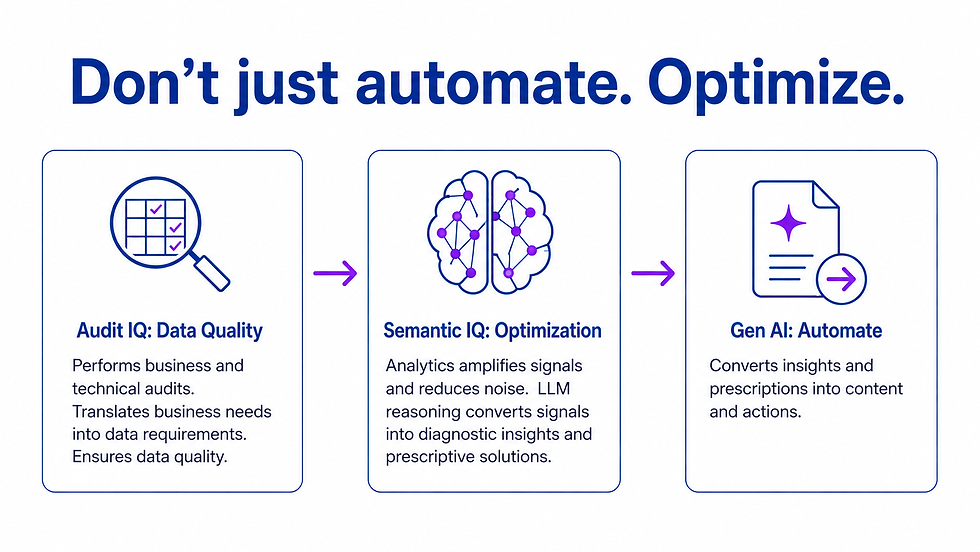
That's Semantic IQ's job. It scans signals continuously, suppresses the noise, and uses an LLM reasoning layer to convert what the data is saying into something a marketer or sales leader can act on this week — not next quarter.
But Semantic IQ can't do that — and can't prove it did it — without two things sitting underneath it.
Optimization requires attribution. Semantic IQ handles both.
You can't claim you optimized anything if you can't measure what changed. That's why attribution sits inside Semantic IQ, not next to it. Optimization without attribution is opinion. Optimization with attribution is evidence.
A few things make this attribution layer worth trusting:
Multi-touch, across the full journey. Most teams attribute conversions only. We attribute awareness, engagement, and conversions — because the channel that drove the first impression and the asset that re-engaged a stalled prospect both matter. Single-touch models flatter the channels closest to the cash register and starve everything upstream.
Attribution windows tuned to reality. A 30-day window misrepresents B2B cycles that take 90. A 90-day window overstates influence in fast B2C purchases. We set windows that match how your buyer actually decides.
Search treated as one thing. Google Search Console and Google Ads are linked to GA4 so paid and organic search can be analyzed together — not in two disconnected tabs.
A baseline established at onboarding. Optimization only makes sense relative to a baseline. Without one, every "improvement" is a story. With one, every change is measurable, compounding, and defensible.
That's what makes Semantic IQ's prescriptions land. They're not guesses — they're moves with evidence behind them, against a baseline that's documented.
Accurate attribution requires data quality. That's Audit IQ.
Here's the catch: attribution is only as good as the data feeding it.
Most marketing and sales teams already have more data than they could process in a lifetime — Google Search Console, GA4, Google Ads, LinkedIn, Meta, the CRM, marketing automation, and product analytics. The problem isn't volume. It's that the data is fragmented across platforms, inconsistently tagged, riddled with tracking gaps, and rarely structured in a way that lets you ask the questions that actually matter.
Point a generative AI model at that mess, and it'll produce confident, fluent, completely unreliable output. Hallucinations dressed up as insight.
Audit IQ ensures that doesn't happen. It runs two passes:
The business audit asks: what data do we actually need to make decisions? This translates business goals into data requirements — and forces a discipline most teams skip when they jump straight to dashboards.
The technical audit asks: is the pipeline actually delivering that data, cleanly? Are conversion events firing across subdomains? Are UTM parameters consistent across campaigns and platforms? Is the GSC ↔ GA4 link in place? Are attribution windows configured correctly?
Run periodically, this becomes continuous data governance — not a one-time cleanup. Every downstream insight rests on it.
Then — and only then — automate.
Once Audit IQ has the data clean and Semantic IQ has produced verified attribution and prescriptive recommendations, generative AI becomes genuinely useful. The same Gen AI everyone else is using — but applied to a foundation that's actually trustworthy.
Content gets written against insights, not assumptions. Campaigns get launched against verified attribution, not guesswork. Automation amplifies optimization instead of amplifying waste.
What this looks like in practice
Consider a mid-market B2B SaaS company with an enterprise product, running Google Ads, LinkedIn campaigns, and an SEO-driven content program. Pipeline is coming in, but the team is convinced LinkedIn and top-of-funnel content aren't pulling their weight. There's internal pressure to cut both and double down on bottom-of-funnel paid search.
Audit IQ runs first. It surfaces three issues nobody was tracking: conversion events misfiring on a subdomain handoff, inconsistent UTM tagging across LinkedIn campaigns, and Google Search Console never linked to GA4 — which meant organic search was effectively invisible in attribution. The data layer gets fixed.
Semantic IQ then establishes multi-touch attribution across awareness, engagement, and conversion, and sets the baseline. A different picture emerges. The team had been operating against Google's default 2-month attribution window, but the actual sales cycle for this enterprise product is closer to 6 months. Extending the window — and properly crediting awareness and engagement touchpoints — reveals that LinkedIn and top-of-funnel SEO content are doing the early work that paid search then closes. They weren't underperforming. They were uncreditable. The prescription is specific: hold investment in LinkedIn and SEO content, sharpen targeting against the segments that actually move through the full 6-month cycle, and stop optimizing paid search as though it were the only thing working.
Gen AI gets switched on last. Now it's producing content and executing tasks against a verified picture of what works — not the team's best guess.
Pipeline stabilizes, then improves. And because the baseline is documented, the team can prove it.
Optimization is the work. Automation is the leverage.
Anyone can buy automation. The hard part — the part that determines whether AI actually makes your marketing and sales smarter — is everything underneath: the data quality that makes attribution accurate, the attribution that makes optimization provable, and the diagnostic depth that makes prescriptions worth following.
That's what Semantic Brain delivers. Optimization as the headline. Attribution and data quality as the foundation. Automation as the payoff.
If your AI strategy doesn't start there, you're just automating guesswork.
Ready to see where the leaks are in your own pipeline? Book a demo with Semantic Brain. Every demo includes a complimentary Audit IQ — a business and technical pass over your marketing data pipeline. You'll see exactly where the leak is, and what it would take to close it, before any commitment.


Comments